










|
Signature Sponsor


By Michelle Bloodworth, CEO, America's Power
Michelle Bloodworth December 18, 2025 - Affordable electricity has become top of mind for consumers, policymakers, voters, and elected officials. Electricity prices for the residential, commercial, industrial, and transportation sectors averaged 6.7% higher in September, compared to the same month one year ago.[i] In particular, residential prices increased by 7.4%, making it especially challenging for lower and middle income families to make ends meet with limited budgets. Electricity expenses this year for the average household are estimated to increase by 10% or more in 10 states plus D.C.[ii] There are many reasons for these price increases, and the reasons vary from state to state. Some of the most often mentioned reasons (in no particular order) are higher demand for electricity caused by data centers and artificial intelligence, overall inflation, volatile fuel costs, weather-related grid repairs, supply chain problems, power plant retirements, shift to cleaner energy sources, expansion of the electric transmission system, and flawed electricity market rules. This is not an exhaustive list, but it shows that maintaining affordable electricity prices is not a simple task with a one-size-fits-all solution.
In the meantime, it makes sense to avoid taking steps that will make electricity less affordable. One of these is to avoid replacing retiring coal power plants with new renewable energy sources.
Energy Ventures Analysis (EVA) analyzed the annual cost of replacing coal power plants that are scheduled to retire with six renewable sources of electricity: solar alone, solar firmed by battery energy storage systems (BESS) or natural gas, wind alone, and wind firmed by BESS or natural gas. BESS and natural gas are firming resources that generate power when the wind isn’t blowing or the sun isn’t shining. However, BESS is expensive and produces power for only a few hours. Natural gas also can be expensive when prices spike, and it is sometimes in short supply, especially during extreme weather.
Almost 42 gigawatts (GW) of coal-fired generation (a total of 46 plants with 79 generating units) have retired or announced plans to retire during 2025 through 2028. (Some utilities have been postponing coal retirements because of electricity demand, and this trend is likely to continue.[iii]) EVA estimated the annual cost of continuing to operate these coal plants and compared that to the cost of building and operating the six renewable resources mentioned above. While the exhibits below summarize some of the results of the analysis, we encourage you to read the entire EVA paper which explains in more detail the results, methodology, data sources, and assumptions.
Cost
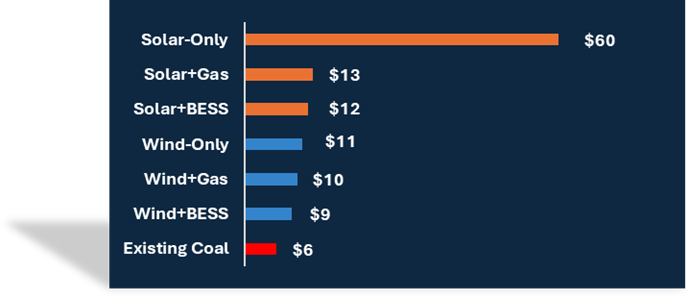
Exhibit 1 shows the annual cost to continue operating the 79 retiring coal units and the annual cost of building and operating replacement sources of electricity. The analysis shows, for example, that replacing retiring coal plants with new solar panels would be ten times more expensive than continuing to operate the coal plants ($6 billion in annual costs for the coal plants and $60 billion in annual costs for solar panels to replace the coal plants).
Exhibit 1: Annual Cost ($ Billions)
The higher cost for renewables would ultimately result in higher electricity bills. However, the magnitude of the increases would vary by state and region and are beyond the scope of the EVA analysis.
Replacement Capacity
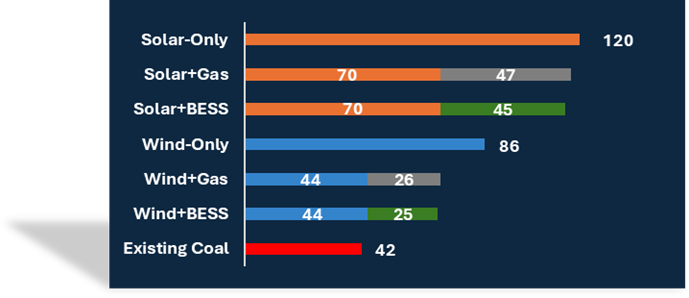
Exhibit 2 shows the amount of generating capacity required to replace 42 GW of retiring coal capacity. Solar+gas and solar+BESS show the capacity of solar power (orange) plus the firming capacity (grey for natural gas and green for BESS). For example, solar+gas means 70 GW of solar plus 47 GW of natural gas. Similarly, wind+gas and wind+BESS show the amount of wind capacity (blue) plus firming capacity (grey for natural gas and green for BESS).
Exhibit 2: Generating Capacity (GW)
These results show the amounts of necessary replacement capacity, but the amounts alone do not take into account the loss of certain reliability attributes that coal provides and renewables do not.[iv] For example, replacing 1 GW of coal with approximately 3 GW of solar would lead to the loss of certain reliability attributes and result in a less reliable grid.
Final Word
America’s Power supports an all-the-above strategy, and this analysis shows one reason why coal is an essential part of such a strategy. The EVA analysis is not intended to discredit renewables, but rather to show that renewables are not always the best way to maintain affordable electricity prices.
[i] U.S. Energy Information Administration, “Electricity Monthly Update,” November 25, 2025.
[ii] U.S. Congress Joint Economic Committee – Minority, “State-by-State Data: Annual Electricity Bills up $100 Per Family in 2025,” November 2025. The largest percentage increases are DC–22.1%, IN–16.3%, IL–15.2%, TN–14.5%, NJ–13.6%, WA–13.2%, ME–12.5%, MA-12.4%, KY-11.8%, and LA-10.1%. The average nationwide increase is estimated to be $100 per household this year.
[iii] Utilities in 19 states have reversed or delayed the retirement of 58 coal-fired generating units because of reliability concerns and load growth.
[iv] See, for example, MISO “System Attributes Workshop,” September 21, 2022. MISO lists a number of attributes that are necessary for grid reliability, including long duration at high output, essential reliability services, and fuel assurance.
|









|